
Basement Flooring in Lawrence IN - a floor that stands up to slab moisture
Damp, cold or musty basement floor? We test the slab first, then put down a floor that suits what your concrete is doing.
- Licensed and insured.
- Free on-site estimates.
- Expect a reply within 1 business day.
What's the right floor for a basement slab in Lawrence?
Basement flooring in Lawrence, IN, is the coating or covering that goes over your concrete slab, and whether it holds comes down to the moisture moving up through that slab, so we check the slab before you pick a floor.
Most people call us when the basement floor feels cold, smells a little damp or has an old coating that's seen better days, and they want something better before they finish the room. The price moves with the size of the room, what has to come off first, how much repair the concrete needs, and whether you're coating the slab or building an insulated floor over it. The schedule turns mostly on the slab, because a water problem or old tile that needs testing gets sorted before any floor goes down, and an old coating or glue may mean concrete floor stripping and removal comes first. Your written estimate spells out what we'd do and why, so you know what you're paying for before you say yes.
How do you know your basement floor needs work?
A musty smell down low
If the smell is strongest near the floor, moisture is usually coming up through the slab or getting trapped under carpet or pad. The longer it sits, the more chance mold has to settle into whatever is lying on the concrete.
White powder on bare concrete
That chalky white dust is usually mineral salt left behind as water moves through the slab and dries at the surface. Put a floor over it without dealing with the moisture and the same push ends up under your new floor.
Paint or coating peeling off
Peeling in patches usually means the coating went onto concrete that wasn't ground clean or tested for moisture. Rolling another coat over it just gives the next layer the same weak spot to let go from.
Old tiles cracking or lifting
Loose tile usually means the adhesive underneath is giving way, often from moisture. Don't pry up older tile yourself yet, because some of it needs testing first, which we cover in the questions below.
How we handle basement flooring, from the slab up
On a basement job I start with the concrete, not the floor. We check the slab for moisture and old coatings, then talk through insulation and headroom with you, because those two decide what can go down and how high it'll sit. If there's a water problem or old tile that might hold asbestos, I'll tell you it needs handling first and point you to testing, before anything gets torn up. Once the slab is clear, our crew grinds it to clean concrete, fills cracks and low spots, and puts the floor down in the order the maker of that system calls for.
Most of the work that decides how a basement floor holds is concrete grinding and surface preparation, since a coating only grips as well as the surface under it. If you'd rather keep the look of bare concrete, concrete sealing is the lighter route we'd talk through with you.
A coating right on the slab
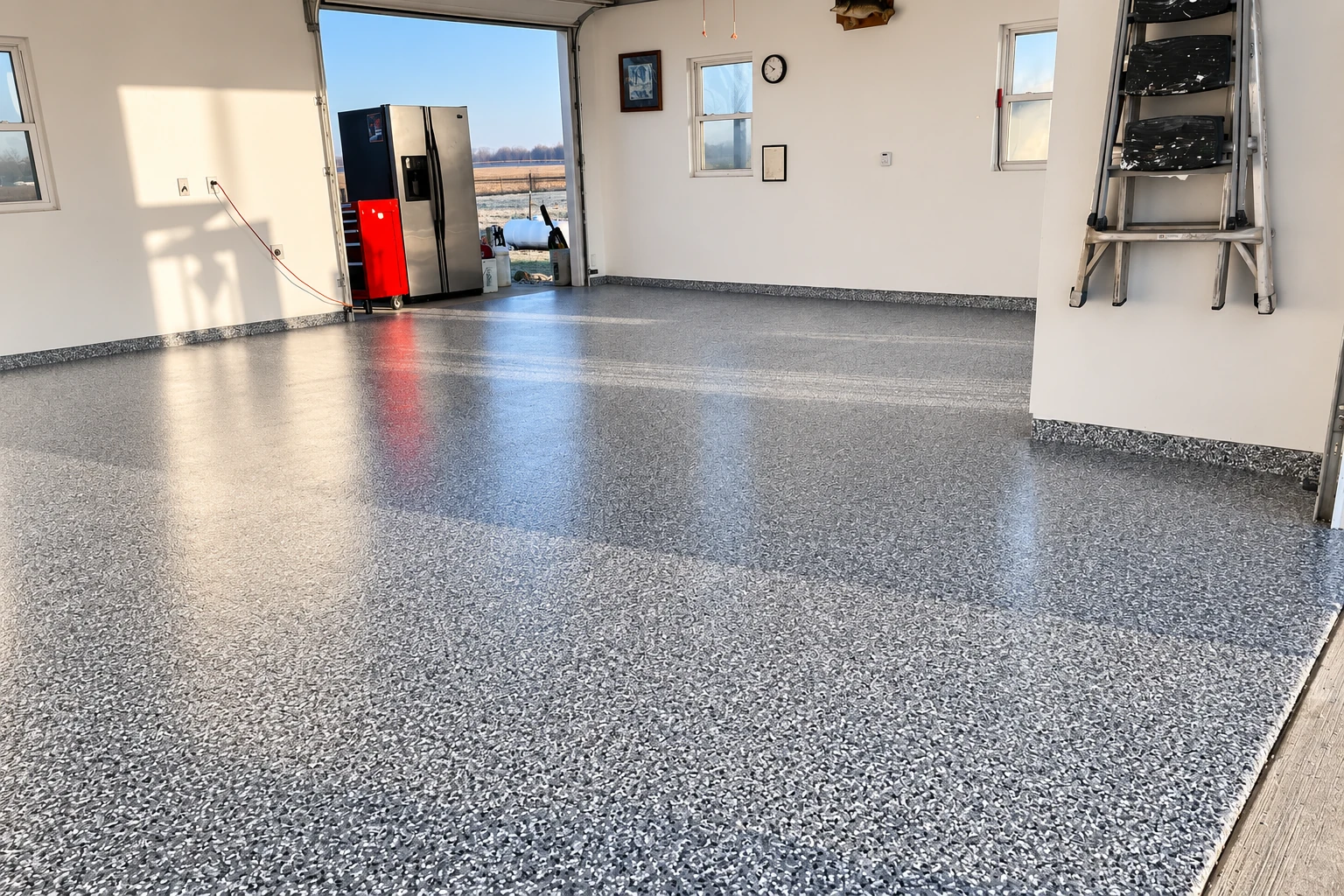
An epoxy or polyaspartic coating over a ground, tested slab suits laundry rooms, storage, workout spaces and kids' play areas. If your basement is mostly utility space, this is the one I'd pick, because there's nothing laid over the concrete to hold moisture or soak up a spill.
Sealed or polished concrete
This suits a slab that's already in decent shape when you want the least between you and the concrete. It keeps the cost and the build height down, though it won't hide much patching or staining.
An insulated base for a finished room
If you're turning the basement into a family room and want a warmer floor or a soft covering, the usual route is building an insulated layer over the slab. It takes up ceiling height, so we measure before anyone plans around it.
Get a written plan for your basement floor
We reply within one business day to set up a visit. The estimate is free and on site, there's no obligation, and I'll write up what we'd do with your slab and why.
(317) 463-6468- Based in
- Lawrence, IN 46226
- Hours
- Mon–Fri: 8 AM–10 PM, Sat–Sun: 6 AM–9 PM
What happens after you call about your basement floor?
Here's how a basement floor job runs from your side, from the first call to the walk-through at the end.
Call or send a request
Reach us at (317) 463-6468 or through the form, and we'll set a time for me to come out. A rough idea of the room's size and what's on the floor now helps me plan the visit.
I check the slab on site
I look at the floor, check the concrete for moisture and old coatings, and ask how you use the space. Then we talk through which system fits, including whether insulation and headroom are part of the picture.
Read your written estimate
You get it in writing, with what we'd do to the slab, which floor goes on it and why. Nothing is buried in it, so you can compare it fairly and ask about any line before you decide.
We prep, install and walk it
Once you're ready, our crew preps the slab and puts the floor down. At the end we walk the finished floor with you so you see it before we call it done.
Why Lawrence homeowners call us about basement floors
The owner walks your floor
I come out to look at the floor and write the estimate myself, and our own crew does the prep and the install while I check the work along the way. You talk to the person who'll answer for the job, from the first visit to the last.
Slab prep is our specialty
We've been in business since 2017, nine years now, and I learned the trade running prep crews and fixing floors that didn't hold. That's why we're best known for careful slab prep, which is where a basement floor wins or fails.
Credentials you can check here
We're licensed and insured. Lawrence also requires anyone contracted for construction work in the city to be a Registered Contractor, and a contractor needs that registration to get permits, so it's fair to ask about it of anyone you're comparing.
Satisfaction guaranteed on every job
That's our promise, and it's why I'd rather spend the time on the concrete underneath than rush the part you see. Nearly every failed floor I've seen came back to the slab.
If you know whether your slab has insulation, whether water ever comes in, how high the ceiling is and roughly how old the current floor is, have it handy and send us a request or call (317) 463-6468.
Basement floors, permits and older slabs in Lawrence
In Lawrence, the City of Lawrence Department of Public Works issues all building permits, and the city requires one before an owner alters or repairs a building or structure. Whether your basement floor needs one depends on what the project involves, so the department is the place to ask about yours, and when it's unclear, we check with that office before we start. When a job does need a permit, we file for it and tell you where it stands. If you're doing the work yourself, the city allows homeowners to get permits for their own work in certain circumstances, and the department can tell you if yours qualifies.
A lot of the basement slabs we see around Lawrence have been painted, carpeted or tiled at least once, and some have two or three layers stacked up. We take the floor down to bare concrete and look at it before we promise anything, and we run into the same layered floors on jobs in Fishers and Carmel.
Questions about basement flooring in Lawrence
How do I know if my basement slab is too wet for new flooring?
You test it, and flooring makers generally require a moisture test before anything goes down on concrete. Too much moisture coming up can make a floor let go, ruin the finish and lead to mold underneath. If someone hands you an old result, ask when the slab was tested, because a reading only tells you what the slab was doing that day.
Can I put carpet or vinyl on my basement slab?
Not on an uninsulated slab, if you follow federal energy guidance, which advises against carpet or vinyl there because they trap moisture and invite mold. So the first thing to find out is whether your slab has insulation under it. If it doesn't, a coating or sealed concrete is the simpler choice, or you insulate first.
How do I insulate a basement slab before putting down a floor?
Usually by building up over the slab you have, with rigid foam, water control measures and a floating subfloor, a base that's laid loose, on top. Tearing out the slab and pouring a new one over insulation is rarely considered practical because of the cost. That build-up raises the floor, so ceiling height gets checked against the building code before work begins, and where there isn't room, the guidance's minimum is to patch and seal the slab to the foundation wall and use epoxy paint to hold back soil gas and moisture.
Should I fix basement water problems before putting in a new floor?
Yes, significant or persistent water in a basement gets treated before the slab is sealed. A floor put over standing or seeping water is money spent twice, so we won't lay one until the water is handled. Once it is, we come back to the slab and pick up from there.
Where can I get a free radon test or asbestos test near Lawrence, IN?
Marion County Public Health offers a free radon test you can request at 317.221.2266, and it can also test building materials for asbestos. The county notes asbestos was used in floor tiles and recommends a locally certified asbestos contractor whenever that material gets disturbed, so older tile gets tested before it comes up. Radon is worth testing before a sealing job too, because if the house needs a radon stack, it goes in before the urethane sealant and epoxy paint.
How much does basement flooring cost in Lawrence?
I give you a figure in a written estimate after I've seen the slab, because the cost comes from that concrete and the floor you choose. A coating on a sound, dry slab is usually the lower end. Tearing out old tile, repairing a rough slab or building an insulated floor over it pushes the price up.
Related concrete work for basement floors
Concrete Grinding & Surface Preparation
Most basement slabs carry paint, glue or a sealer from years back, and grinding takes it down to clean concrete so a new coating has something to grip.
Concrete Sealing
If you'd rather keep the basement as bare concrete, a sealer cuts dust, makes spills easier to mop up and gives the floor a cleaner finished look.
Cities we cover for basement floors
Lawrence Epoxy Floors and Concrete is based in Lawrence, Indiana, and works across the cities around it, including Fishers and Greenfield. The 12 cities below have their own pages, and if yours isn't listed, just ask.
Lawrence, IN
Book a slab check for your basement
A moisture reading on your own slab tells you which floors are worth pricing before you spend a weekend shopping for one.